
These essays seek to show Valley Forge, not just as a symbol of suffering, but as a living community of care, labor, and ingenuity. We hope you enjoy these essays, written by Valley Forge Muster Roll team member, Andrew Stevenson.
“A Winter Holyday: Christmas at Valley Forge, 1777”
Valley Forge is often remembered in winter images: soldiers standing in snow without shoes, Washington in a cloak beside his horse, a suffering army transformed by discipline. Within that larger story, Christmas looms large in popular imagination—as if the entire encampment could be summed up in a single frozen holiday scene. The reality was more complicated. When December 25, 1777 arrived, the Continental Army had been at Valley Forge less than a week. The camp was still taking shape, food was scarce, and the army’s diverse religious traditions meant there was no single way to mark the day.
Christmas at Valley Forge was not a grand tableau but one hard winter day inside a much longer crisis. It is best understood through the fragments that survive: orders and letters from George Washington, diary entries from surgeons and junior officers, and the army’s own lists of names. Read alongside the Valley Forge Muster Roll (valleyforgemusterroll.org), these traces help reconstruct what “holyday” could mean in a camp where survival was the first priority.
A camp still being built
When the army marched into Valley Forge on December 19, 1777, it did not find a prepared cantonment; it began building one. Regiments were assigned ground, timber details went out, and men felled trees, dragged logs, and began laying out the grid of huts that would become their winter city. Washington offered cash rewards for the best, most efficient hut designs—an early attempt to spur both innovation and morale.
By Christmas, many units were still between tents and finished quarters. Some soldiers slept in partly built cabins open to the wind; others remained in worn canvas shelters while their huts rose around them. The Muster Roll can list which regiments were present in camp on December 25—Pennsylvania, Massachusetts, Virginia, North Carolina, and others—but it cannot show the crooked chimneys, smoky interiors, or frozen hands that shaped that day’s experience. It simply marks that they were there.
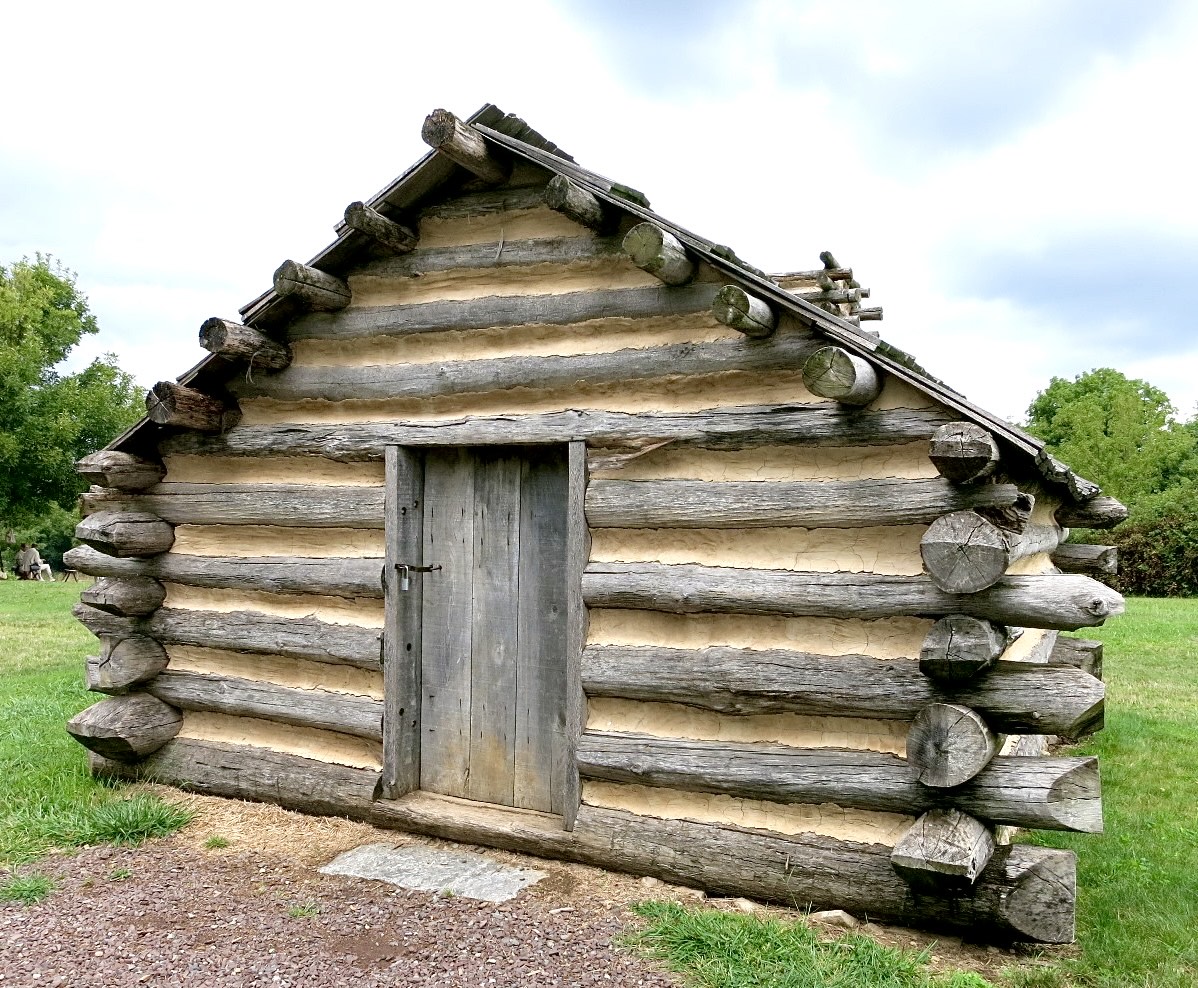
Soldier’s Hut at Valley Forge
Who celebrated Christmas—and who did not
The Continental Army was religiously diverse, and that diversity shaped how (or whether) Christmas mattered at all. Among officers and enlisted men were Anglicans (soon to be Episcopalians), Lutherans, Congregationalists, Presbyterians, Baptists, Methodists, Quakers, Jews, Black soldiers whose beliefs blended African, Christian, and sometimes Islamic traditions, and Native allies and auxiliaries.
For some of these communities, December 25 was a major feast day. For others—especially those in the strict Reformed and Quaker traditions—it was at best an ordinary winter workday, at worst a suspicious “popish” custom. Earlier in the century, New England Puritans had gone so far as to ban Christmas celebrations in the name of sobriety and discipline. That spirit lingered in many corners of the army.
This meant that on December 25, 1777, different units may have experienced the day in very different ways. An Anglican chaplain might have gathered officers for a brief service, reading familiar Scripture and prayers amid bare trees and raw timber. A Presbyterian company commander might have treated the date as one more Friday of fatigue duty and drill. For most, the line between holyday and workday blurred in the press of immediate needs: food, warmth, and the slow work of turning Valley Forge into a functioning encampment.
“To complete their rations”: Christmas in the orderly books
Washington’s own words about the day are characteristically practical. On December 24, 1777, he ordered that “every regiment is to draw provisions, to complete their rations, for to morrow”—a simple directive that reveals how modest his expectations were. The most realistic “celebration” he could promise was the hope that each soldier might at least receive a full ration of food.
On Christmas Day itself, Washington continued his usual rhythm of correspondence. Among his letters was one to North Carolina’s Governor Richard Caswell, passing along news that a French ship had arrived in New Hampshire with arms and military stores—an early sign that foreign aid might begin to alter the balance of the war. Even on December 25, there was no pause in the work of securing supplies, managing relations with the states, and planning for the next campaign season.
Weather added to the mood. Snow fell around Christmas, and by December 26 several inches covered the ground. The scene that later artists would mythologize—a white landscape, a cloaked commander, a struggling army—did have a basis in fact. But in 1777, no painter stood by with a canvas; only the orderly books and letters recorded the day.
Hunger, firecakes, and “my Christmas frolick”
The most vivid accounts of Christmas at Valley Forge come from the rank and file. They show a holiday overshadowed by hunger.
- Surgeon Albigence Waldo, serving with a Connecticut regiment, had already described the army’s diet earlier in December: meat and bread when available; at other times, “firecake”—a paste of flour and water baked on stones or scrap iron. Firecakes could keep a man alive but offered little nourishment, and soldiers frequently complained that they made them sick.
- Around the time of the encampment’s first national day of thanksgiving—December 18, 1777—another medical officer, Jonathan Todd Jr., recorded that the army’s “feast” was little more than beef, flour, and a small measure of rice per man. It was hardly a table to inspire holiday cheer. Thanksgiving passed into Christmas with stomachs still rarely full.
- On December 25, Lieutenant Samuel Armstrong, a New Hampshire officer, tersely summarized his own holiday in his diary. The regiment had no provisions. He was sent out to procure food, returned to camp, and was immediately ordered out again on scouting duty. He did not come back until late that night. With a soldier’s dry humor, he labeled that long, hungry day “my Christmas frolick.”
Taken together, these voices suggest that for many men, Christmas was not a feast but a continuation of scarcity. The Muster Roll’s notations of “sick,” “present,” or “on command” hint at such experiences; the diaries fill in the human frustration behind the terse administrative categories.
Philadelphia feasts, Valley Forge firecakes
The contrast between Valley Forge and British-occupied Philadelphia sharpened the emotional edge of the holiday. Only a short distance downriver, British officers, loyalist families, and well-connected Philadelphians passed the winter with plays, balls, and elaborate dinners. Their social season would later culminate in the famous Meschianza—a grand May 1778 fête in honor of General William Howe—but even at Christmas their tables were far richer than anything seen in the huts on the Schuylkill.
American civilians in the countryside had their own modest celebrations. One Quaker diarist recorded a Christmas dinner that included roast turkey, puddings, and mince pies. Such meals were not universal in wartime Pennsylvania, but they were real enough to form a painful contrast with the army’s rations.
For Continental soldiers, the knowledge that Christmas might mean a well-laid table for others did not necessarily translate into bitterness against civilians. Waldo, for example, used his observations to scold those Americans who complained about the war’s inconveniences while enjoying relative comfort. Yet the juxtaposition remained stark: firecakes and thin broth at Valley Forge; better-fed households and British banquets in nearby Philadelphia.
Myth, memory, and the “Valley Forge Christmas”
Later generations overlaid this complicated reality with powerful symbols. Nineteenth- and twentieth-century artists and writers often distilled the entire encampment into a single winter image: Washington kneeling in the snow; an army shivering in rags; a lone, candle-lit hut on Christmas Eve. These stories and images drew on genuine hardships but rearranged them into a kind of American Passion narrative, with Christmas at Valley Forge standing in for sacrifice and eventual redemption.
In some versions, the encampment appeared as a crucible that produced a new, more disciplined army by the end of winter. In others, it served mainly as a backdrop for pious vignettes about Washington’s personal faith. Either way, the messy diversity of religious practice in the Continental ranks, the unevenness of observance, and the simple fact that many soldiers spent the day on guard duty or foraging largely dropped out of view.
What the surviving records suggest instead is quieter. There may have been small religious gatherings in some regiments, extra efforts by officers to arrange a slightly better meal, or moments of song and camaraderie in the huts. There were also empty bellies, sore feet, and a sense among many that this Christmas was defined less by celebration than by endurance.
Christmas, names, and the Valley Forge Muster Roll
The Valley Forge Muster Roll offers a way to anchor these scattered voices in specific lives. It lists officers like Washington, Nathanael Greene, and Friedrich von Steuben—names that later artists would link to iconic Valley Forge imagery. It also records junior officers such as Samuel Armstrong and dozens of surgeons and surgeon’s mates like Albigence Waldo and Jonathan Todd Jr. These are the people whose words allow us to reconstruct what December 25, 1777 felt like.
Behind each entry—“present,” “sick,” “on command,” “deserted”—lay an individual whose holiday might have included a hurried prayer, a thin stew, a snow-covered march, or a lonely watch by a smoky fire. By pairing the Muster Roll’s data with diaries, letters, and orderly books, it becomes possible to see “Christmas at Valley Forge” not as a single scene, but as thousands of overlapping experiences, all unfolding in the same unfinished winter city.
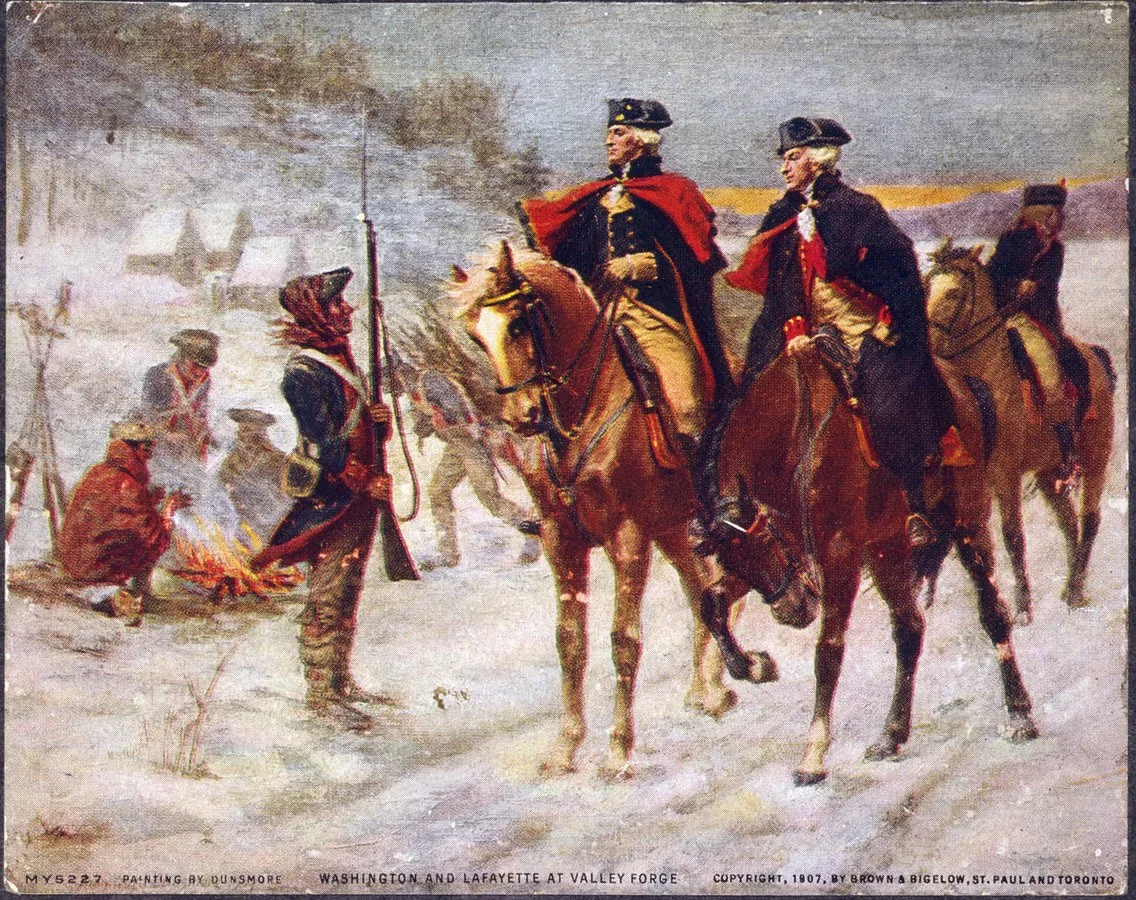
George Washington and Gilbert du Motier, marquis de Lafayette at Valley Forge during the winter of 1777-78. Reproduction of a painting by John Ward Dunsmore, 1907.
Library of Congress, Washington D.C.
Places to explore the story
- Valley Forge National Historical Park (PA) – Interprets the encampment on the original ground. Winter programs, reconstructed huts, and wayside exhibits help visitors imagine the conditions soldiers experienced around Christmas 1777.
- Valley Forge Park Alliance – Valley Forge Muster Roll (online) – A digital roll call of the encampment, listing regiments and individuals present on December 25, 1777, and throughout the winter. An essential tool for linking specific names to the broader story of the encampment (valleyforgemusterroll.org).
- Library of Congress & Founders Online – Repositories for Washington’s letters, including his correspondence from December 1777 that reveals how little the work of command paused for holidays.
- Published diaries and orderly books – Editions of journals by Albigence Waldo, Jonathan Todd Jr., Samuel Armstrong, and other Continental officers preserve firsthand details of rations, weather, and daily duty around Christmas at Valley Forge.
Christmas at Valley Forge did not offer the army much in the way of festivity. Instead, it required soldiers and families to carry their own memories of home and faith into an encampment still under construction, where the best gift many could hope for was a full ration and a sturdy roof. Seen through the Muster Roll and surviving firsthand accounts, that winter holyday becomes not a single iconic picture, but a mosaic of endurance at the heart of the Revolution.

The Surgeon of Yellow Springs: Dr. Bodo Otto and the Healing of an Army
Physician, immigrant, patriot—Dr. Bodo Otto Sr. (c. 1711–1787) turned Enlightenment medicine into a weapon for survival. He did not lead charges; he led wards. During the Valley Forge period he served as Surgeon-in-Chief of the Continental Army’s general hospital at Yellow (Chester) Springs, the centerpiece of a regional medical network that tried—against weather, disease, and want—to give Washington’s army a fighting chance. Earlier, in 1777, he directed smallpox inoculations at Trenton’s Old Barracks, helping to carry out George Washington’s bold decision to immunize the troops. Together those assignments show how science, organization, and care became instruments of victory. (Explore PA History)
An immigrant physician steps into a revolution
Otto arrived from the Electorate of Hanover in the 1750s and settled among Pennsylvania’s German-speaking communities, practicing medicine first in Philadelphia and then in Reading. Well before the war, he stood in civic life—opposing the Stamp Act and serving on the Berks County Committee of Public Safety—before offering his profession to the Patriot cause. A Pennsylvania marker at his Reading home captures both the arc of his career and the esteem in which he was later held. (Explore PA History)
The invisible enemy: smallpox
Disease killed more soldiers in the Revolution than bullets or bayonets, and nothing terrified commanders more than smallpox. In February 1777, Washington concluded that the only way forward was universal inoculation of susceptible troops—a risky policy, but one he believed would “have the most happy effects.” Orders and letters that winter laid out the plan and the routes through which recruits would be inoculated before joining the line. (Founders Online)
Trenton: medicine as strategy
That same year, the Old Barracks at Trenton became a Continental Army hospital under Dr. Bodo Otto, and inoculations began in earnest. It was a turning point: preventive medicine, performed under wartime pressure, became part of the army’s strategy. The result was not just fewer cases of smallpox—it was a restored capacity to fight. (Old Barracks Museum)
Yellow Springs: the hospital that served Valley Forge
By the winter encampment at Valley Forge (1777–78), Yellow Springs—also called Washington Hall—was the principal general hospital serving the encamped army. Contemporary and commemorative accounts describe Otto as Surgeon-in-Chief at the site and credit the hospital with a reputation for discipline and competent management in an era when medicine’s tools were limited and logistics were everything. Washington himself visited the hospital; over the course of the war, smaller posts were consolidated there before the facility finally closed in 1781. Today the stabilized ruins at Historic Yellow Springs mark the footprint of that work. (Explore PA History)
Inside those walls, the hard tasks were rarely glamorous: securing fuel for heat, bedding and clean linens for the feverish, wine and food for the convalescent (therapeutic in the 18th-century sense), and enough paid staff to keep wards clean. Otto’s surviving petitions and letters (summarized in family and institutional listings) show him pleading for firewood, straw, pay, and provisions—reminders that victory depended as much on supply and sanitation as on courage. (The Dr. Bodo Otto Family Association)
A family’s answer to attrition
Otto did not serve alone. Two of his sons joined him in Continental medical service, part of a broader pattern of families stepping into the new nation’s needs. Their presence at Trenton and Yellow Springs underscores how knowledge and kinship sustained the medical workforce when trained practitioners were scarce. (Modern site histories and memorial texts preserve that record.) (Old Barracks Museum)
Memory, myth, and what endures
Public memory has honored Otto across the region: a state marker at 525 Penn Street (Reading); his grave at Trinity Lutheran Church; the ruins and interpretive landscape at Historic Yellow Springs; and a plaque at Washington Memorial Chapel in Valley Forge’s Cloister of the Colonies, dedicated by descendants in 2006. Museums in Reading have exhibited Otto’s portrait and surgical instruments, preserving tangible links to his work. Commemoration can sometimes compress a life into a single line of praise; the sources above invite a more textured view—one that balances honor with the daily, difficult labor of keeping people alive. (HMDB)
Why tell this story now?
For America 250, Otto’s career reframes Valley Forge. The iconic images of rag-wrapped feet and snow give way to other images: inoculation tables; hospital lists and returns; a surgeon arguing for straw and fuel so the fevers do not kill. It is a story about public health as strategy, about immigrant expertise anchoring a fragile army, and about the moral weight of care when rations, clothing, and hope run thin. In that sense, Otto’s wards were also battlefields—and the victories won there, though quieter, helped secure the louder ones to come. (National Park Service)
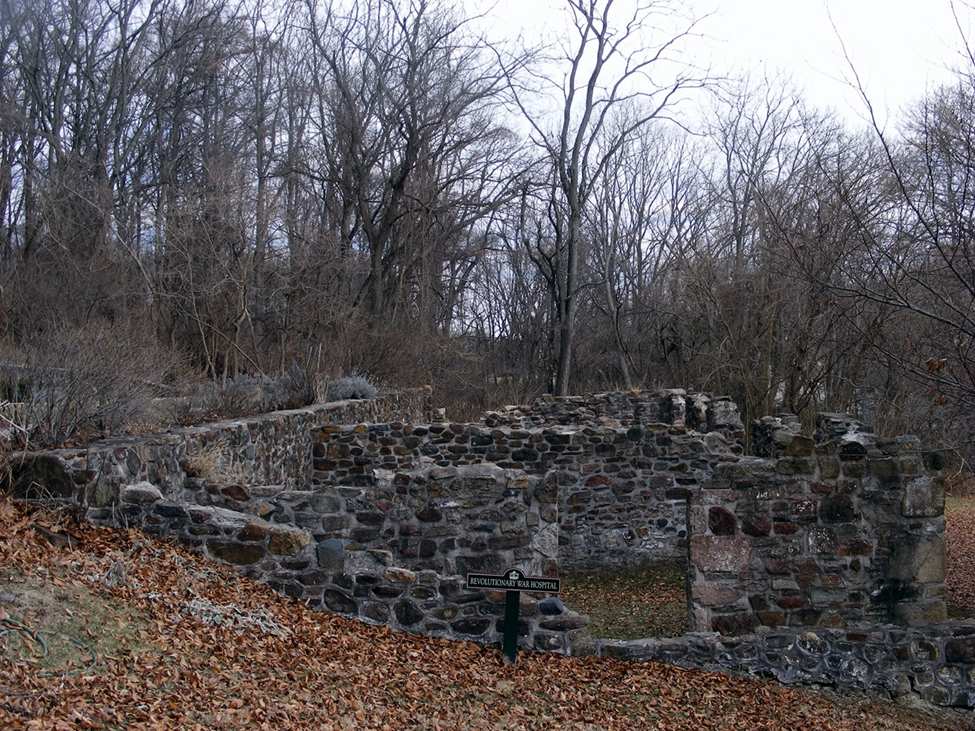 Copyright, road_less_trvled on Flickr. https://flic.kr/p/4GgkG9
Further reading & sources
- ExplorePAHistory (PHMC): “Dr. Bodo Otto” and “Chester Springs” historical marker pages (context on Otto’s role as Surgeon-in-Chief and the Yellow Springs hospital). (Explore PA History)
- Old Barracks Museum (Trenton): “Building Legacy” (site history noting 1777 hospital status under Dr. Otto and oversight of inoculations). (Old Barracks Museum)
- Founders Online (National Archives): Washington to William Shippen Jr., Feb. 6, 1777 (mandating inoculation); supplemental orders and correspondence. (Founders Online)
- George Washington’s Mount Vernon / NLM exhibit: Washington to Lt. Col. David Grier, Mar. 12, 1777 (operationalizing the inoculation plan). (George Washington’s Mount Vernon)
- NPS: “Smallpox, Inoculation, and the Revolutionary War” (overview of disease and policy). (National Park Service)
- AMEDD Center of History & Heritage / U.S. Army Center of Military History: chapters on Pennsylvania hospitals and Yellow Springs (structure, consolidation, closure). (Achh Army)
- Historic Yellow Springs: site history and ruins/porch pages (Washington Hall, present-day landscape). (Historic Yellow Springs)
- Historical Marker Database (HMdb): “Site of the home of Dr. Bodo Otto” (Reading). (HMDB)
- Berks History Center: museum and collections (public talks and exhibits featuring Otto artifacts). (berkshistory.org)
Note: Dates and roles above follow institutional sources; where family and local traditions add detail (e.g., the Valley Forge chapel plaque text or specific artifact attributions), those are identified through the Dr. Bodo Otto Family Association site and partner institutions. (The Dr. Bodo Otto Family Association)
Sidebar (optional for publication): Visiting the story
- Historic Yellow Springs (Chester Springs): hospital ruins and interpretive landscape. (Historic Yellow Springs)
- Old Barracks Museum (Trenton): 18th-century barracks complex with exhibits on wartime medicine and inoculation. (Old Barracks Museum)
- Washington Memorial Chapel (Valley Forge): Cloister of the Colonies memorials (including the Otto family plaque). (The Dr. Bodo Otto Family Association)
- Reading, PA: state marker at 525 Penn Street; Trinity Lutheran Church cemetery; Berks History Center collections. (HMDB)
This is a story for public memory not because it flatters the past, but because it clarifies it: armies are sustained by courage, yes—but also by the quiet insistence that organization, science, and care are acts of patriotism.
Two Virginians in the Snow: The Humphries at Valley Forge
On November 12, 1775, a father and son from King George County, Virginia—John Humphries Sr. and John Humphries Jr.—enlisted together. Their decision pulled them from a Tidewater farm into the hardest winter of the war. By December 1777, their regiment stood with Washington’s army at Valley Forge, a half-year encampment that demanded more stamina than glory. (National Park Service)
From Virginia to Valley Forge
The Humphries served in the 1st Virginia State Regiment under Col. George Gibson, a state-establishment unit that Virginia committed to the northern war effort during the Philadelphia Campaign. At Valley Forge the regiment was placed in Muhlenberg’s Brigade (Stirling’s Division), part of the Virginia wing on the army’s North Outer Line. The brigade’s composition that winter is well documented: the 1st, 5th, 9th, and 13th Virginia Regiments, the 1st and 2nd Virginia State Regiments, and the German Regiment. (Valley Forge Muster Roll)
A winter measured in numbers
Valley Forge was not a single image of suffering; it was a moving ledger of men gained and men lost. The 1st Virginia State Regiment entered camp with 444 men assigned, only 188 “fit for duty,” and left with 335 assigned, 203 fit—a stark snapshot of attrition and recovery. Across the encampment as a whole (December 19, 1777–June 19, 1778), roughly 12,000 soldiers and several hundred civilians turned this ridge into what contemporaries called a “city of huts.” Mortality—driven overwhelmingly by disease—approached 2,000 dead. (Valley Forge Muster Roll)
Two notations, one life
The Valley Forge Muster Roll lists Private John Humphries in Capt. John Nicholas’s company through the winter months and then preserves two conflicting death notations: “Died March 26, 1778” and “Died, June 1778.” The project’s editors intentionally retain such conflicts because their sources—monthly company returns, hospital rolls, later abstracts—do not always agree. The contradiction is itself part of the historical record, not an error to be erased. (Valley Forge Muster Roll)
Why the records disagree—and why March likely matters
The paper trail of 1777–78 was created under duress: clerks closed company books late; hospitals kept separate ledgers; and consolidated regimental returns often summarized “died” at month’s end. A camp hospitals report of April 27, 1778 counts heavy spring losses at Uwchlan/Red Lion, Yellow Springs, and French Creek Church—with French Creek’s fatalities beginning March 21. That pattern matches a specific March 26 death more closely than a vague June line on a later return. Recent analysis of the encampment’s six months likewise shows a mortality surge in March–May (about 1,900 recorded deaths overall, likely more in total). (Founders Online)
A careful way to present the fact: Died 26 March 1778 (hospital/return sources); also carried as “Died, June 1778” on a consolidated regimental return. This phrasing is transparent, historically honest, and common in Revolutionary-War documentation.
Inside Muhlenberg’s Brigade
Visitors today can still walk a reconstructed company street at the Muhlenberg Brigade Huts, stand near a rebuilt redoubt, and grasp the scale of a brigade that blended state and Continental units. These huts—twelve men to a cabin by regulation—anchor public interpretation of the soldiers’ routine: drill, fatigue duty, guard, inoculations, and, for too many, illness. The brigade site and monument mark the ground on which the Virginia regiments, including the 1st Virginia State Regiment, endured and reorganized. (National Park Service)
The larger arc: from survival to a marching army
Valley Forge sits between defeat and recovery in the Philadelphia Campaign. After losing Philadelphia in autumn 1777, Washington chose high ground near the Schuylkill for winter quarters—defensible, close enough to monitor the enemy, and spacious enough to train. Over six months the army stabilized supply, improved sanitation, and adopted von Steuben’s drill. When the soldiers marched out on June 19, 1778, they were a different force; nine days later, they stood their ground at Monmouth. The Humphries story fits that arc exactly: a father carried on winter returns until death; a son likely marched with a regiment that now moved and fought with discipline. (American Battlefield Trust)
Why this matters for America 250
As the Semiquincentennial approaches, the Humphries of King George County remind us that the Revolution was not only made by strategists and statesmen. It was also made by neighbors whose names survive as brittle lines on muster returns—men who endured shortages, disease, and the long cold of 1777–78 so that a national army could emerge in the spring. Their story invites the public to read the record closely, to accept contradiction where the sources demand it, and to see in those small entries a larger civic inheritance. (Valley Forge Muster Roll)
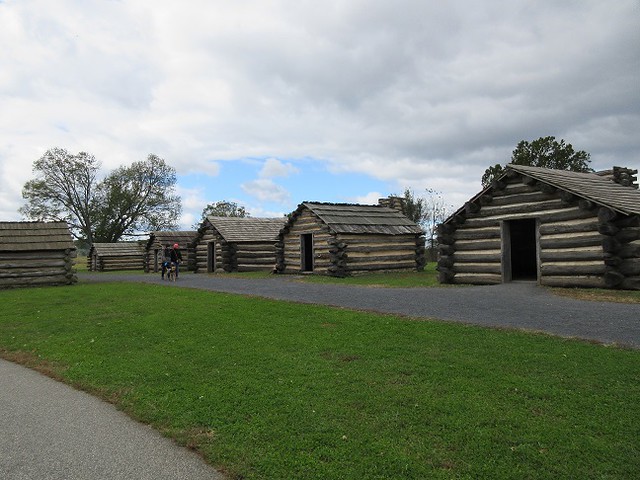
Muhlenberg Huts – Valley Forge Park Alliance flickr, Photo credit – Carey Avenia
Works consulted
- Valley Forge National Historical Park (NPS), What Happened at Valley Forge? (encampment overview; dates; scale). (National Park Service)
- NPS, The Encampment (public interpretation; population & landscape). (National Park Service)
- Valley Forge Muster Roll (Valley Forge Park Alliance), 1st Virginia State Regiment (Muhlenberg’s Brigade; strength on entry/exit). (Valley Forge Muster Roll)
- Valley Forge Muster Roll, Search the Muster Roll (project methodology; why conflicting entries appear). (Valley Forge Muster Roll)
- Valley Forge Muster Roll, Muhlenberg’s Brigade (brigade composition). (Valley Forge Muster Roll)
- NPS, Muhlenberg Brigade Huts and Muhlenberg’s Brigade (site descriptions; reconstructed huts & redoubt). (National Park Service)
- Founders Online, A Report of the Camp Hospitals, 27 April 1778 (French Creek, Yellow Springs, Uwchlan/Red Lion counts). (Founders Online)
- Journal of the American Revolution, Gary Ecelbarger, “Permanent Losses and New Gains During the 1778 Valley Forge Encampment” (mortality estimates; spring surge). (Journal of the American Revolution)
- American Battlefield Trust, “Valley Forge Encampment” (strategic rationale & terrain). (American Battlefield Trust)
- Friends of Valley Forge, 1st Virginia Regiment (to distinguish Continental line from state establishment in the same brigade). (friendsofvalleyforge.org)